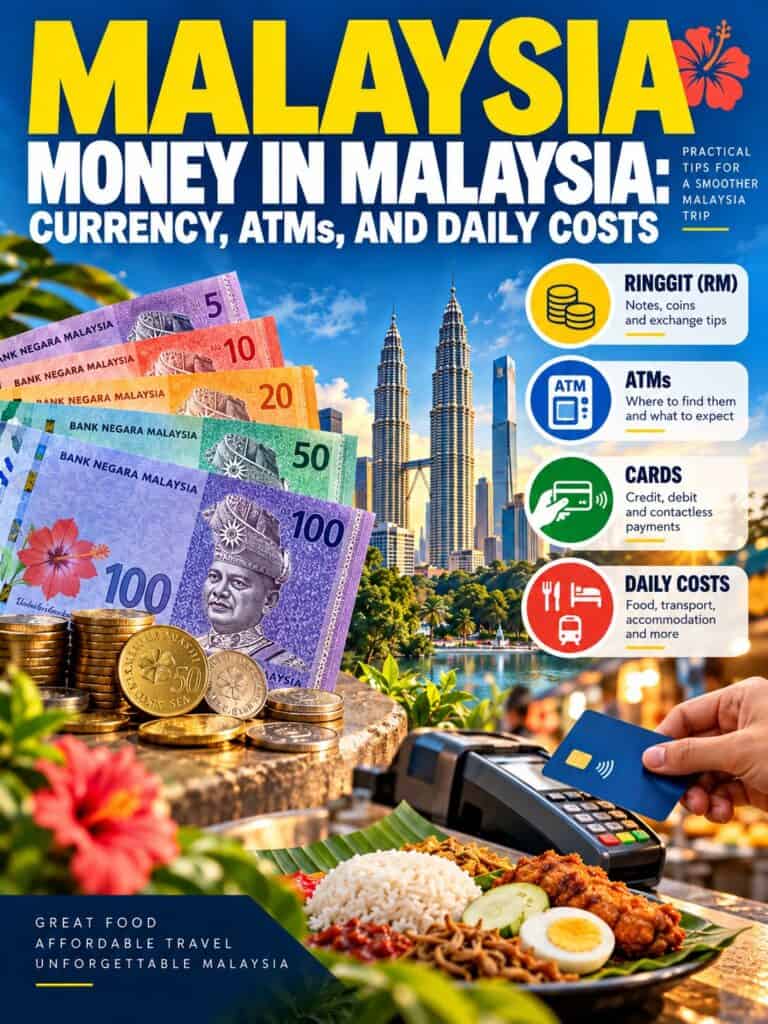
The currency of Malaysia is the Malaysian ringgit (MYR), written with the symbol RM. Banknotes come in RM1, RM5, RM10, RM20, RM50 and RM100, and coins cover amounts below RM1. Cash is still the simplest way to pay at hawker stalls, markets and small shops, while cards work in hotels, malls and larger restaurants, and QR payments are common with locals.
Handling the Malaysia currency is straightforward once you know the basics. Malaysia runs a mixed cash-and-card economy: your Visa will work at a mall in Kuala Lumpur and may be useless twenty minutes later at a hawker stall. Knowing which situation calls for which, and how to get cash without losing money to markups, makes the difference between a smooth trip and a string of small frustrations.
Malaysia Currency: The Malaysian Ringgit, Notes and Coins
The Malaysian ringgit is issued by Bank Negara Malaysia. Banknotes in circulation are RM1, RM5, RM10, RM20, RM50 and RM100, and the older RM500 and RM1,000 notes have been withdrawn. Smaller notes are the most useful for hawker food and tips, and larger ones for hotels and bigger purchases. Coins are used for amounts under RM1 in 5, 10, 20 and 50 sen. Since the 1-sen coin was phased out, cash totals are rounded to the nearest 5 sen. Check the central bank’s currency pages for the current note designs.
The exchange rate moves daily, so this guide does not quote one. Check a live rate on a currency app or your bank on the day you travel, and compare it with what any exchange counter actually offers. We also keep any fixed USD to MYR figure out of titles for that reason.
Currency Exchange in Malaysia: Airport, Bank, Moneychanger or ATM
| Option | Typical rate and fees | Best for |
|---|---|---|
| Licensed moneychanger in a mall | Often the best cash rates, usually no commission | Exchanging cash in Kuala Lumpur, Penang and other tourist centers |
| Bank counter | Safe and regulated, rates often slightly worse than moneychangers | Larger amounts and peace of mind |
| Airport exchange counter | Convenient but rates are usually less favorable | A small amount for the first taxi or train |
| Hotel front desk | Usually the least favorable rate | Emergencies only |
| ATM with a foreign card | Rate set by your card network and bank, plus any ATM or bank fees | Topping up cash when you need it |
The numbers below are illustrative only, to show how a small difference in rate adds up. If you exchange the equivalent of USD 500 and a counter gives you a rate 1 percent worse than the market, you lose about USD 5. At 5 percent worse, you lose about USD 25. Compare the final ringgit amount you will receive, not the headline rate, and always ask whether there is a commission.
Malaysia Currency at ATMs: Fees, Limits and DCC
ATMs are everywhere in cities and tourist areas and are usually the easiest way to get ringgit. Costs come from up to three places: a fee from the local bank, a fee from your own bank, and a currency conversion margin. Many guides say several Malaysian banks do not add a surcharge for foreign cards, and any surcharge should appear on the screen before you confirm, so check the screen. Your own bank may still charge an ATM fee and a foreign transaction fee, so look at your card’s terms.
Withdrawal limits for Malaysia currency vary by bank and by the notes in the machine, and per-transaction caps of around RM1,500 to RM3,000 are commonly reported, so do not assume one number applies everywhere. Your own bank also sets a daily cap, so ask your card issuer before you travel.
Dynamic Currency Conversion: Choose Ringgit
When an ATM or a card terminal asks whether to charge you in your home currency or in ringgit, choose ringgit. The home-currency option, called dynamic currency conversion (DCC), lets the machine set the exchange rate, which is often less favorable than the rate your own bank or card network would apply. The size of the difference varies, so there is no guarantee of savings, but ringgit is the safer default.
Paying with Malaysia Currency and Cards: Where Plastic Works
Visa and Mastercard are accepted at most hotels, malls, restaurants and larger shops in cities. American Express and UnionPay are patchier. Card acceptance drops in local settings such as hawker stalls, wet markets, night markets and small family-run shops, and many taxis prefer cash, as do rural areas. That said, many stalls now display a QR code, so the old rule of cash-only is less absolute than it used to be, especially in cities. Carry enough cash for food and small purchases, and rely on cards for hotels and bigger retail.
How Much Cash Should You Carry in Malaysia?
There is no single right amount, because it depends on where you are and how you pay. Use these scenarios as a guide, and top up from ATMs rather than carrying everything at once.
| Situation | Cash advice |
|---|---|
| City days with hawker food and public transport | Carry small notes and coins for meals, snacks and transit, and use a card for bigger spending |
| Markets and night markets | Bring cash in small denominations. Some stalls take QR payments, but not all |
| Taxis and short rides | Use a ride-hailing app or a taxi that accepts cards if you can, and keep cash as a backup |
| Smaller islands and rural areas | Withdraw enough ringgit in a city first, since ATMs may be scarce or run out, and carry small notes |
| Hotels, malls and larger restaurants | A card is usually fine |
Keep a small cash reserve separate from your daily cash, and top up before heading to islands such as those in our Langkawi guide or Perhentian Islands guide.
Touch ‘n Go eWallet and DuitNow QR
Touch ‘n Go eWallet is Malaysia’s dominant digital payment app, used for tolls, public transit, parking, retail and a growing number of hawker stalls. Many shops show a DuitNow QR code, which lets one code work across several wallet apps and banks. Foreign visitors can in many cases register with a foreign mobile number and a passport, complete identity verification (eKYC), and top up with an eligible overseas card, but eligibility, verification steps, wallet limits and top-up fees for foreign cards change, so confirm the current rules in the app before you rely on it. Foreign card top-ups have been reported to carry a convenience fee of up to about 2.6 percent. Treat the wallet as a bonus, and still carry cash and a card. GrabPay, linked to the Grab app, is a simpler alternative for many visitors. Mobile data helps with all of this, so see our guide to SIM cards and eSIMs.
Tipping and Malaysia Currency Etiquette
Tipping is not expected in Malaysia, and service staff are paid regular wages. Many restaurants add a 10 percent service charge to the bill, which covers what a tip would elsewhere. Tour guides are the main exception where a small tip is appreciated, though never obligatory. Hawker vendors, taxi drivers and hotel staff generally do not expect anything extra.
Malaysia Currency and Daily Budget by Travel Style
Prices in Malaysia currency change with the season, the city and exchange rates, so we describe budgets by what they cover rather than quoting figures that go out of date. Check current rates for your dates.
| Style | Typically covers | Notes |
|---|---|---|
| Backpacker | Hostel dorms, hawker food, local transport and modest activities | Cheap if you eat at hawker stalls and use trains and buses. See our 10-day Malaysia itinerary for a route |
| Mid-range | A comfortable 3-star hotel, mixed hawker and restaurant meals, transport and some tours | Hotel choice varies by area. See our Kuala Lumpur hotel guide |
| Luxury | High-end hotels, resorts, fine dining and private transfers | Resort areas such as Langkawi can cost much more than the cities |
Eating well is one of the cheapest parts of a trip, as our Malaysian food guide and guide to KL hawker centers show, while hotels and transport such as flights or ferries are usually where a budget grows. For trips across the country, see our northern Malaysia road trip and the guide to getting around Kuala Lumpur.
Frequently Asked Questions About the Malaysia Currency
What is the currency of Malaysia?
The Malaysian ringgit (MYR), written RM. Banknotes come in RM1, RM5, RM10, RM20, RM50 and RM100, with sen coins for smaller amounts.
What currency is used in Kuala Lumpur?
The Malaysian ringgit, as everywhere in Malaysia. Prices in shops, restaurants and taxis are quoted in RM.
Can I use US dollars in Malaysia?
Not for everyday purchases. Prices are in ringgit and shops expect ringgit. US dollars are one of the easier foreign currencies to exchange at moneychangers, but plan to pay in ringgit.
Do I need cash in Malaysia?
Yes. Cards work in hotels, malls and larger restaurants, but hawker stalls, markets, small shops and some taxis prefer cash, and QR payments are not universal for foreign visitors.
Should I exchange money before I arrive or after?
Usually after, and ideally not at the airport. Licensed moneychangers in malls often offer better cash rates than airport counters, but compare the final ringgit amount.
What is the biggest ATM mistake tourists make?
Accepting dynamic currency conversion when the ATM offers to charge in your home currency. Choose ringgit instead.
Is Touch ‘n Go eWallet worth setting up for a short trip?
For a longer trip, highway travel or heavy public transit use, it can be worth it if you qualify. For a short city stay, cards and cash are usually simpler, and eligibility for foreign visitors changes.
Do I need to tip in Malaysia?
No. Tipping is not expected, and many restaurants add a 10 percent service charge. A small tip for tour guides is appreciated.
Bottom Line
Carry the Malaysia currency in small notes for hawker stalls, markets and taxis, lean on cards for hotels and bigger purchases, and always choose ringgit when an ATM or card terminal offers to convert. For when to go and how to dress, see our packing guide.
Pingback: Is Malaysia Safe for Tourists? A Practical Guide - Malaysia With Me
Pingback: Getting Around Kuala Lumpur: LRT, MRT, and Grab
Pingback: Malaysia Visa Guide: Who Needs One and How to Apply
Pingback: Malaysia Extends Visa-Free Entry for China and India